Forts and Palaces · Jaipur, Rajasthan, India
Amber Fort
Amber (Amer) Fort overlooks Maota Lake near Jaipur and is one of the Hill Forts of Rajasthan inscribed as a World Heritage Site.
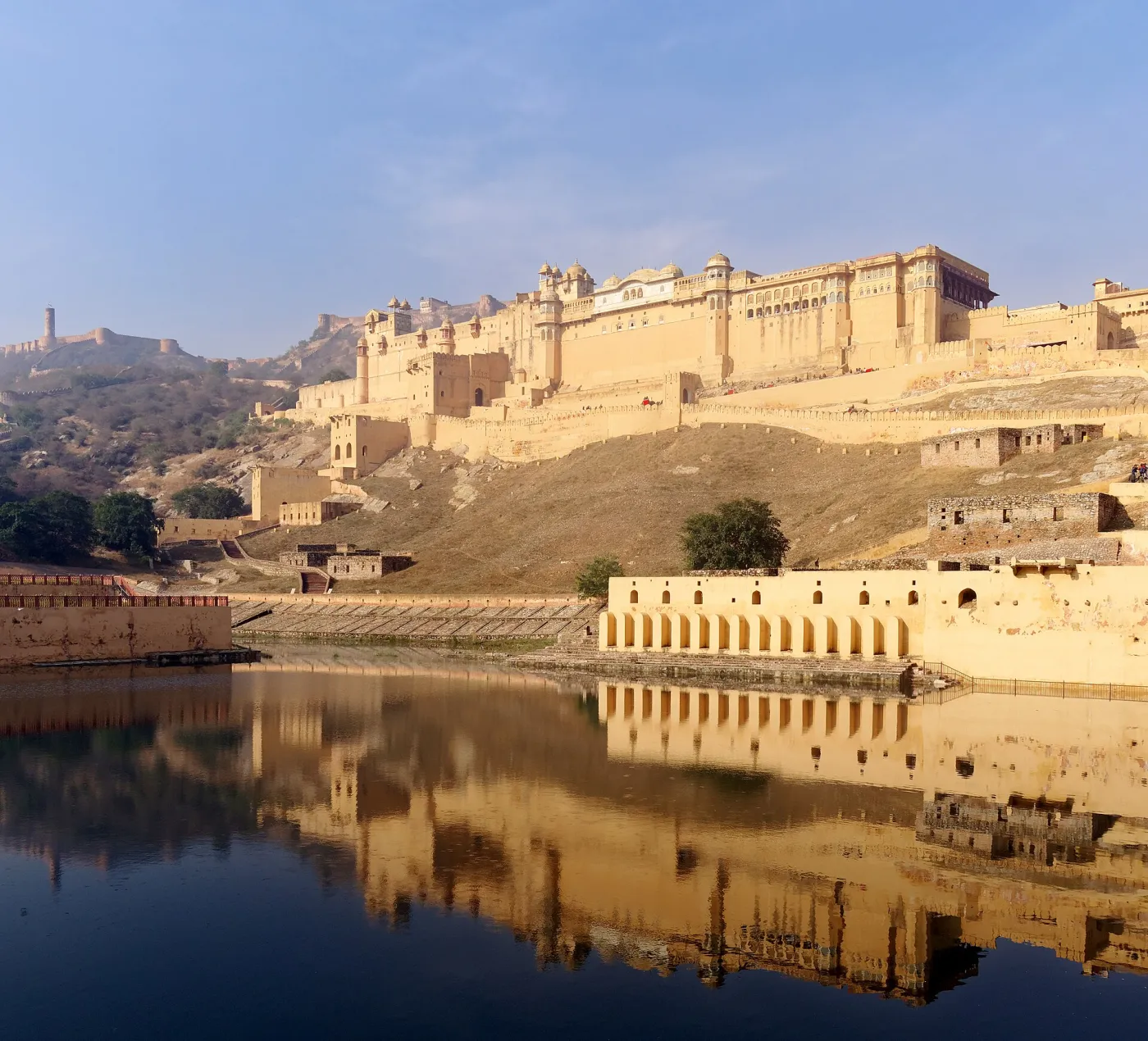
Overview
Drive out of Jaipur towards the Aravalli hills and Amber (Amer) Fort suddenly appears above Maota Lake, its honey-coloured walls climbing the ridge in layers of courtyards and gateways. The approach is as much part of the experience as the palace itself – a long ramp winds up to the Suraj Pol (Sun Gate) and the great courtyard of Jaleb Chowk.
Inside, each courtyard reveals a new world: the pillared Diwan-i-Aam, the painted Ganesh Pol gateway, the Sukh Niwas with water channels for cooling, and most famously the Sheesh Mahal, a hall whose walls and ceiling are covered with thousands of tiny mirrors that glitter with the light of a single flame.
History
Amer was the capital of the Kachhwaha Rajputs before Jaipur was founded in 1727. The present palace was largely built from the late 16th century under Raja Man Singh I, a leading general of the Mughal emperor Akbar, and was expanded by his successors, including Jai Singh I. The fort is connected by fortified walls to Jaigarh Fort on the hill above.
Significance
Amber Fort is one of six forts inscribed together in 2013 as the "Hill Forts of Rajasthan" UNESCO World Heritage Site, recognised for showing how Rajput military architecture adapted to the landscape and combined defence with palace life.
How to reach
The fort is about 11 km north of Jaipur city. Taxis, auto-rickshaws and city buses run from Jaipur; the drive takes around 30 minutes. You can walk up the ramp from the parking area or take a jeep. Ethical-travel groups recommend not riding elephants to the fort.
Frequently asked questions
Is it Amber Fort or Amer Fort?
Is Amber Fort a UNESCO site?
Sources & references
- UNESCO World Heritage List – UNESCO World Heritage Centre (2013) , retrieved 10 Oct 2026 – Inscription year Reported