Historical Monuments · New Delhi, Delhi, India
Qutb Minar
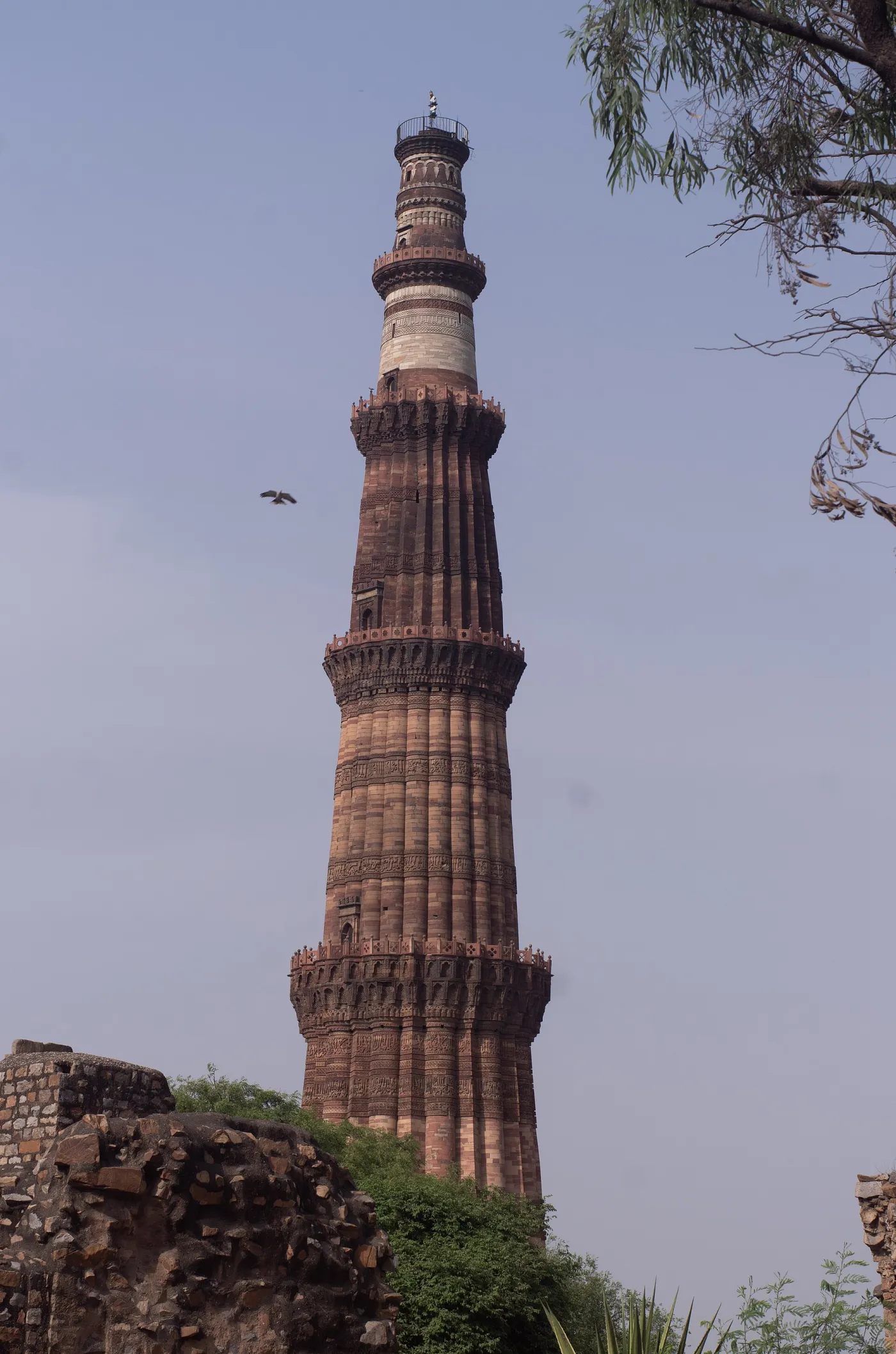
The Qutb Minar is a towering minaret of red sandstone in Delhi, begun in the early 13th century; it stands within a complex of early Islamic monuments.
Overview
Stand at the foot of the Qutb Minar in south Delhi and tilt your head back: the fluted tower of red and buff sandstone rises in five storeys, each ringed by a carved balcony and bands of Arabic calligraphy. Even after eight centuries, it is one of the tallest brick-and-stone minarets in the world and the most striking landmark of early Islamic architecture in India.
The minaret is the centrepiece of the Qutb complex, a garden of ruins that rewards slow exploration. Here you will find the Quwwat-ul-Islam mosque, built partly with columns reused from earlier temples, the elegant Alai Darwaza gateway with its horseshoe arches, the unfinished stump of the Alai Minar that was meant to be twice as tall, and the famous Iron Pillar that has stood for more than 1,500 years with remarkably little rust.
History
Construction of the Qutb Minar began around the end of the 12th century under Qutb-ud-din Aibak, the founder of the Delhi Sultanate, and was continued by his successor Iltutmish. Later rulers repaired and added to the tower after damage from lightning and earthquakes, which is why its upper storeys use white marble alongside sandstone.
The Iron Pillar in the courtyard is much older than the minaret. Its Sanskrit inscription is generally dated to the Gupta period, and metallurgists have long studied how the pillar has resisted corrosion. The complex was inscribed as a UNESCO World Heritage Site, "Qutb Minar and its Monuments, Delhi", in 1993.
Significance
The Qutb complex documents the beginning of Indo-Islamic architecture, when builders combined new forms such as the true arch and dome with local craftsmanship. It is one of the three World Heritage Sites in Delhi, along with Humayun's Tomb and the Red Fort Complex.
How to reach
The complex is in Mehrauli, south Delhi. Qutab Minar station on the Delhi Metro Yellow Line is the nearest metro stop, a short auto-rickshaw ride away. Indira Gandhi International Airport is roughly a 30–40 minute drive depending on traffic.
Frequently asked questions
Who built the Qutb Minar?
Can you climb the Qutb Minar?
What is special about the Iron Pillar?
Sources & references
- UNESCO World Heritage List – UNESCO World Heritage Centre (1993) , retrieved 10 Oct 2026 – Inscription year Reported